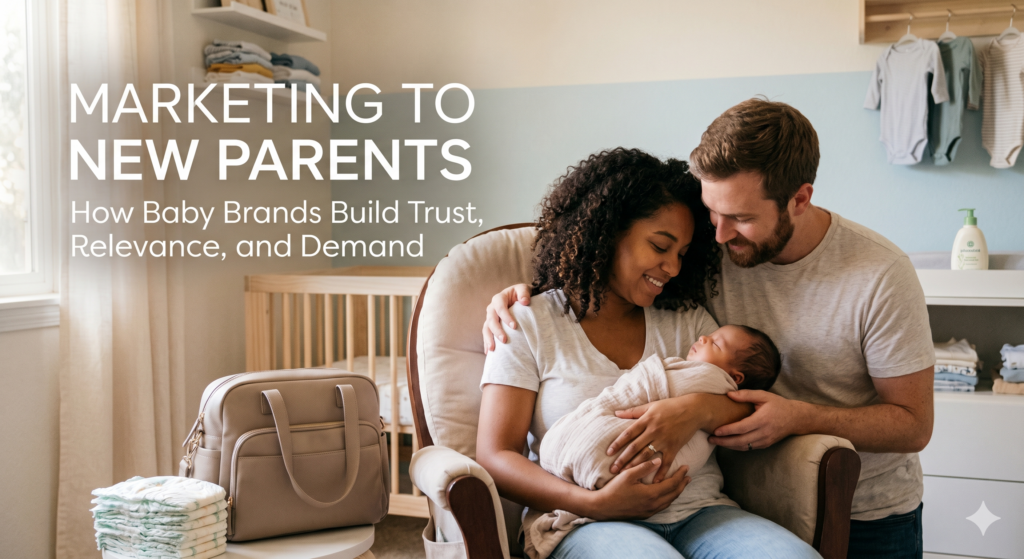
Marketing to new parents is not the same as marketing a product to a general consumer audience. Baby and family brands are entering a decision journey shaped by preparation, uncertainty, trust, timing and emotion. Parents are not only looking for products. They are looking for confidence.
This journey often starts before birth. Expecting parents may begin by researching what they need, what can wait, which products are essential and which brands feel reliable. After birth, the same audience becomes more problem-led: sleep, feeding, mobility, clothing, skincare, routines, safety, convenience and daily use. A strong baby brand understands both stages and builds content, campaigns and ecommerce experiences around them.
For baby brands, this makes marketing less about pushing a message and more about becoming useful at the right moment. The brands that connect best are usually the ones that explain clearly, reduce hesitation and show that they understand the emotional and practical reality of early parenthood.
Why marketing to new parents requires a different approach
New parents are not just a demographic segment. They are people moving through a major life transition. Their buying decisions are often slower, more researched and more trust-sensitive than in many other consumer categories.
Safety, practicality, comfort, product fit, reviews, materials, delivery, returns and brand credibility all matter. But so do emotion, identity, aesthetics and the feeling that a brand understands what this moment is like. Generic marketing rarely works well because it does not answer the real question behind the purchase: “Can I trust this?”
Expecting parents: the pre-birth trust window
Marketing to expecting parents should feel supportive, not pushy. During pregnancy, many families are still learning the category. They may not know which product features matter, which purchases are urgent, or which brands are genuinely relevant.
This stage is ideal for educational content: preparation checklists, buying guides, comparison articles, nursery planning resources, FAQs and calm explanations of what to consider before buying. The goal is to help expecting parents feel oriented before asking them to convert.
For example, a baby brand can build early trust by explaining what to prepare before birth, what questions to ask before choosing a product, how to compare materials or features, and what can be postponed until after the baby arrives.
New parents: the post-birth decision journey
After birth, needs often become more immediate. New parents may search with urgency, compare faster, revisit product pages several times, or look for reassurance from reviews, recommendations and practical product information.
This is where baby brands need content and ecommerce experiences that reduce friction. Product pages should explain use cases, materials, size or age fit, care instructions, delivery, returns and why the product is suitable for a specific family situation.
What new parents are really looking for
- Clear product explanations.
- Trust-building brand signals.
- Useful educational content.
- Simple comparison support.
- Reviews, proof and reassurance.
- A buying experience that feels calm and easy.
How baby brands can build trust before demand
Demand often begins before a parent searches for a specific product. It may start as uncertainty: what do we need, what matters, what is safe, what other parents recommend, or what will make daily life easier?
Brands can build trust before demand by publishing content that answers early questions and makes the category easier to understand. This can include stage-based guides, founder notes, product education, comparison frameworks, expert-led content and FAQs that address real doubts.
When a parent later becomes ready to buy, the brand is no longer unfamiliar. It has already been useful.
The key pillars of marketing to new parents
1. Trust comes before persuasion
In baby categories, trust is the first conversion layer. Brands that push too hard too early often lose ground. Brands that explain well, communicate calmly and support decision-making are more likely to earn confidence.
2. Relevance matters more than reach
Not every parent needs the same message. Expecting parents, new parents, gift buyers, first-time parents and returning customers may all require different content angles.
3. Education supports conversion
Educational content is not only top-of-funnel. In baby categories, it can directly support conversion by helping people compare options, understand product value and reduce uncertainty.
4. Brand positioning shapes performance
A baby brand needs to explain who it serves, what it stands for and why it deserves trust. Clear positioning improves SEO, paid media, product pages, social content and email.
How SEO helps brands reach parents at the right moment
Search is especially valuable because parents actively look for information, comparison and reassurance. A strong SEO strategy should capture product-led keywords, educational searches, category questions and comparison intent.
Useful SEO content for baby brands can include buying guides, FAQs, product comparison articles, category explainers, trust-led blog posts and service pages connected through internal links.
How paid media and social content fit in
Paid media can accelerate discovery, support launches and retarget interested visitors. Social media can build familiarity, show product use, answer objections and surface real parent questions.
The best results usually come when channels are connected. SEO attracts intent, paid media supports demand, social builds familiarity, and the website turns that attention into trust.
Common mistakes when marketing to new parents
- Using generic parenting language that could apply to any brand.
- Targeting all parents with the same message.
- Promoting products before explaining why they matter.
- Separating brand, SEO, paid media and ecommerce strategy.
- Ignoring expecting parents as an early trust-building audience.
- Relying on emotional claims without practical proof.
A practical framework for baby brands
- Map the stage: expecting parent, new parent, gift buyer or returning customer.
- Identify the uncertainty: safety, fit, timing, value, usability or trust.
- Choose the content role: educate, reassure, compare, convert or retain.
- Build proof: reviews, product details, policies, expert context or founder perspective.
- Connect the journey: link educational content to product, service and category pages.
- Measure more than sales: track returning users, assisted conversions, branded search and engagement.
FAQs about marketing to new parents
Is marketing to expecting parents different from marketing to new parents?
Yes. Expecting parents are usually preparing and researching before the need becomes urgent. New parents are often solving more immediate routines and product decisions. Both stages need trust, but the content and timing should differ.
What is the most important factor when marketing to new parents?
Trust is usually the first priority. Without trust, even strong products and well-targeted campaigns can struggle to convert.
What content works best for this audience?
Guides, checklists, FAQs, comparison articles, product education, stage-based content and clear product pages usually work well because they help parents make decisions with more confidence.
Should baby brands focus on SEO, paid media or social first?
It depends on the product, market and stage of growth. Most baby brands benefit from connecting all three around the same trust-led strategy rather than treating them as separate channels.
Marketing to new parents works best when brands stop thinking only in terms of promotion and start thinking about trust, timing and usefulness. The strongest brands show up before demand is obvious, support families while they compare, and make the product decision feel clearer when the moment to buy arrives.